Southeast Asian Educators Build Movement for Climate Justice and Just Transition

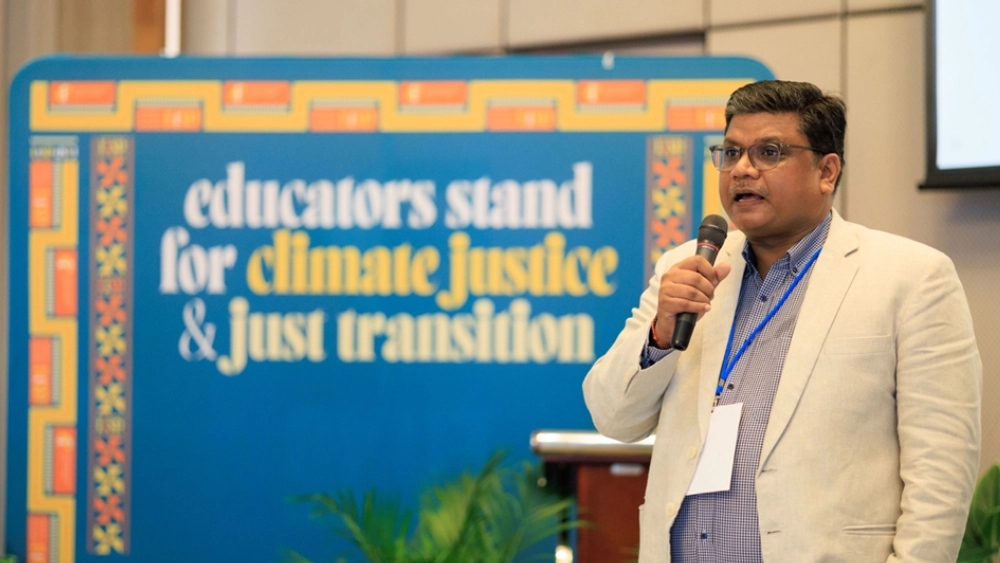
Southeast Asian educators convened to demand climate justice and advance a just transition at a three-day conference hosted by Education International Asia-Pacific (EIAP) in Bangkok, Thailand on April 17-19, 2024.
On its second year, the Educators Stand for Climate Justice and Just Transition conference gathered 50 educator-unionists from Southeast Asia to strengthen capacities in advocating for climate justice and a just transition in the education sector. In his progress report, EIAP Regional Director Anand Singh reiterated that climate change is deepening existing inequalities in education. “Across the Asia Pacific, many teachers work in schools that are ill-equipped to withstand severe climate impacts. Be it scorching heatwaves or violent storms, educational facilities are among the first to buckle. This reality underscores our schools’ urgent need for climate-resilient infrastructure, ensuring they remain sanctuaries of learning and safety amid the changing climate,” he said.
“Across the Asia Pacific, many teachers work in schools that are ill-equipped to withstand severe climate impacts. Be it scorching heatwaves or violent storms, educational facilities are among the first to buckle. This reality underscores our schools’ urgent need for climate-resilient infrastructure, ensuring they remain sanctuaries of learning and safety amid the changing climate.”
Anand Singh, EIAP Regional Director
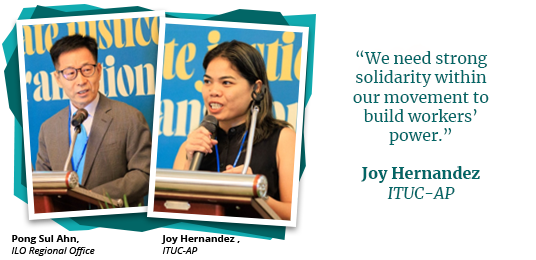
Various experts and allies from multilateral agencies and the trade union movement also graced the event. Joy Hernandez, ITUC-AP senior communications and advocacy officer, highlighted the need for workers’ participation in mapping a just transition to a low-carbon economy in Southeast Asia. “Workers must not be left behind in the transition into a low carbon economy. A way to ensure this is by giving them a seat at the table when planning and implementing just transition proposals… We need strong solidarity within our movement to build workers’ power,” she said. Meanwhile, the ILO’s Pong Sul Ahn delivered a keynote encouraging trade unions to influence decision-making processes for just transition plans. Finally, representatives from the Australian Education Union, Japan Teachers’ Union, Swedish Teachers Union and Union of Education Norway delivered messages of solidarity for movement-building in Southeast Asia and beyond.