
North Asian unions stand for climate justice and just transition
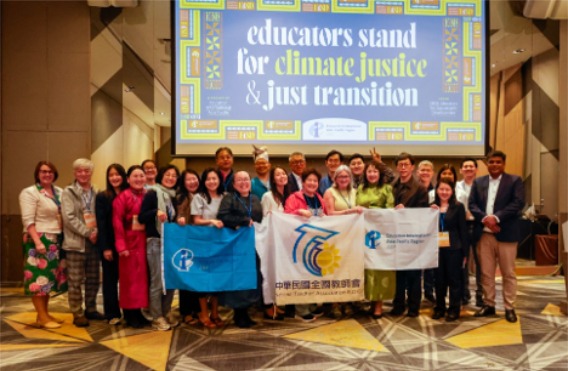
Education unions from Japan, South Korea, Taiwan, and Mongolia reaffirmed their commitment to climate justice and just transition at the ‘Educators Stand for Climate Justice and Just Transition’ conference. The event was organized by Education International Asia-Pacific (EIAP) in Taipei, Taiwan on April 21 to 22, 2026, as part of the Educators for Sustainable Development (E4SD) program.

In its fourth year, union leaders from North Asia discussed the importance of education in ushering a global just transition, especially in shifting societal attitudes on sustainability, ecology, and social equity. Union leaders and representatives from the Japan Teachers Union (JTU), Korean Teachers Union (KTU), Korean Federation Teachers’ Union (KFTU), Federation of Mongolian Education and Science Unions (FMESU), and the National Teachers Association – Taiwan (NTA Taiwan) also shared how climate change is already affecting the teaching profession in their respective countries because of harsher winters and worsening heat stress inside the classroom. They also shared that curriculum reforms regarding climate change education and professional training to address climate anxiety among students are pressing concerns for their members.
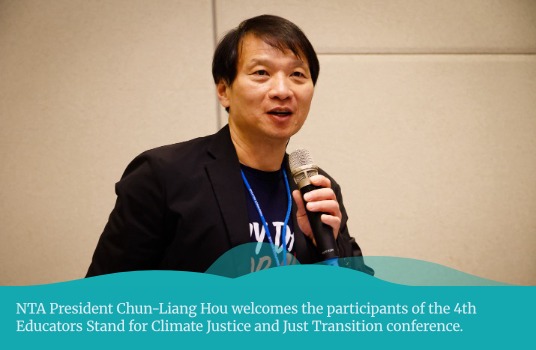
NTA Taiwan President Chun-Liang Hou welcomed delegates, expressing that it was the union’s honor to host such an important event, especially as NTA highlighted its commitment to climate action. Mr. Wei Yang, a research fellow at the Taiwan Climate Action Network, delivered the keynote address, in which he called for rethinking the purpose of education in the climate emergency era. Meanwhile, Mr. Satoshi Tamai, Director at the ITUC-AP, joined the conference remotely and called on governments to prioritize long-term climate responsibility and implement climate policies that uphold the rights and welfare of workers and their communities.
Longtime EIAP partners Beverley Park, Director of International Cooperation Program of the Canadian Teachers’ Federation, and Nicole Calnan, Federal Secretary of the Australian Education Union, delivered solidarity messages emphasizing that unionists can display real leadership on climate action for their students and that teaching is foundational to democracy and climate justice.
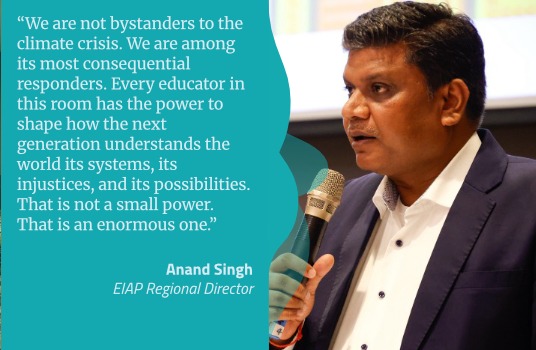
In his opening remarks, EIAP Regional Director Anand Singh reminded the audience of the potency of the teaching profession as a force for meaningful change. “We are not bystanders to the climate crisis. We are among its most consequential responders. Every educator in this room has the power to shape how the next generation understands the world its systems, its injustices, and its possibilities. That is not a small power. That is an enormous one,” he said.
With Mongolian, Chinese, Korean, Japanese, and English speakers in attendance, the conference was also a shining example of how education unions can promote multilingualism and practice international collaboration. In his closing speech, Singh commended the unionists for their diligence and cooperation and said that he hoped this would extend into their work on quality climate education.

He outlined four concrete expectations after the conference: a clearer shared picture of where climate education stands in each country; two or three practical union commitments per affiliate for the next twelve months; a stronger North Asia network; and above all, the confidence that comes from knowing “from Japan to Korea, from Taiwan to Mongolia, there are educators and union leaders who share this commitment and who stand with us.”

The conference culminated in the North Asian education unions crafting national climate action plans detailing their activities and commitments, including seminars, collective action, and lobbying for curriculum reforms, which shall be implemented in 2026.