
Southeast Asian educators rally for wider climate consciousness, ‘the right to quality climate education for all’
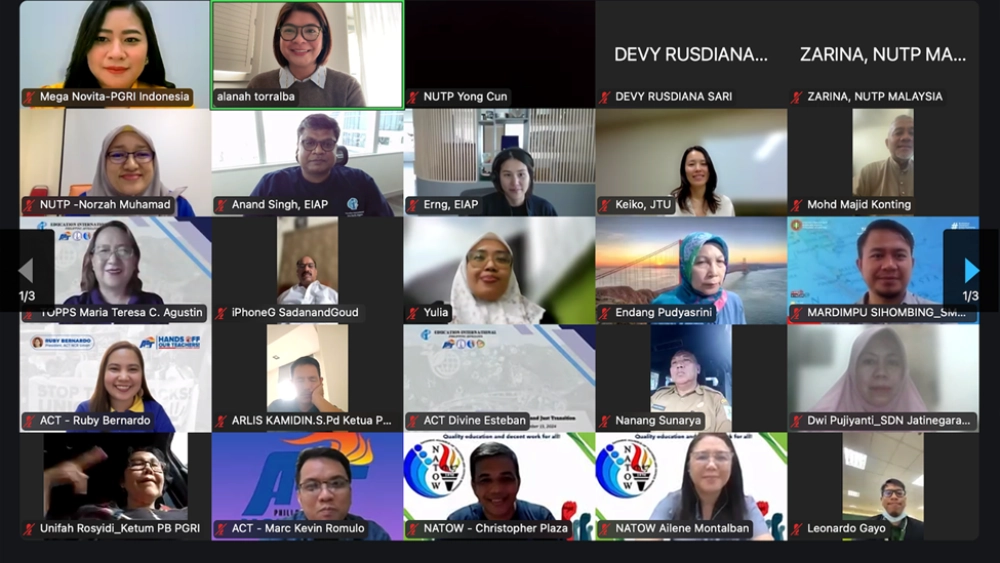
More than 100 Southeast Asian educators gathered to discuss union strategies to raise awareness on the climate crisis and demand quality climate education for all at the 5th E4SD Climate Justice series last March 2025. The webinar also gave a recap of EIAP’s E4SD activities in Southeast Asia in 2024.
Union leaders from Persatuan Guru Republik Indonesia (PGRI), National Union of the Teaching Profession – Malaysia (NUTP), National Alliance of Teachers and Office Workers (NATOW) and Alliance of Concerned Teachers (ACT Philippines) discussed their work related to advancing climate justice and a just transition in the education sector, which included school-wide workshops, teacher trainings, awareness-raising campaigns, and policy influencing.
NUTP Malaysia’s Norzah bin Muhamad opened the program by discussing the union’s project titled “Climate is Our Friend” Awareness Raising Day in October and November 2024. It sought to deepen the understanding on climate change among teachers and emphasize their critical role in educating students about the climate crisis. The program started by asking school officials to submit a proposal on awarenes-raising activities, which were reviewed by NUTP. Schools that met the criteria were given funds from the EIAP E4SD program to conduct awareness-raising activities, which included an environmental clean-up, art-making competitions and gardening. By teaching sustainability and ecology through hands-on learning, the “Climate is Our Friend” program aimed to inspire the youth to promote these sustainable practices in their communities, bin Muhamad said.
The ‘’Climate is Our Friend’ Awareness Raising Day sought to deepen the understanding on climate change among teachers and emphasize their critical role in educating students about the climate crisis.
PGRI’s Mega Novita presented the union’s 2nd International Conference on Digital Education and Social Sciences, which was a collaboration between PGRI, APPI (PGRI’s Association of Scientific Publication Administrator) and EIAP. The in-person program which was held in Jakarta, Indonesia aimed to integrate climate change into educational and organizational strategies for sustainability. It was also broadcast on PGRI’s Youtube channel and Zoom, providing access to the union’s 3.3 million members. In February 2025, PGRI also initiated EduClimate, an online workshop for teachers in collaboration with the Korean Teacher Union on innovative and interactive teaching strategies about climate change.
NATOW’s Dr. Avelino Caraan shared their joint initiative with the Teachers Organization of the Philippine Public Sector (TOPPS), Federation of Free Workers (FFW) and ACT Philippines, which included a climate summit and creating a national manifesto, which included a declaration on quality climate education as a right for all. Borne out of the E4SD Conference 2024, the collaborative national climate action plan aimed to raise awareness about climate justice and a just transition in the education sector. NATOW and TOPPS gathered 32 delegates for a two-day National Summit on Climate Justice and Just Transition, which provided a space for meaningful dialogue and collective action aimed at navigating the complexities of working towards climate justice in the education sector and beyond. According to Dr. Caraan, the Filipino unions believe that the way forward is to promote climate justice in education, workers’ rights in the green transition and stronger community engagement for sustainability.
ACT Philippines’ Ruby Bernardo talked about their union’s climate justice work, particularly on their quick response to the prolonged heatwaves in 2024. ACT Philippines engaged with the government to campaign to shift the school calendar to avoid the hottest months, the release of emergency funds for climate adaptation in schools, overtime pay for educators and health personnel, the inclusion of unions during consultations on emergency protocols and integrating quality climate education in the curriculum. The group won the reversion of the school calendar which will be implemented in the coming school year, Bernardo said.
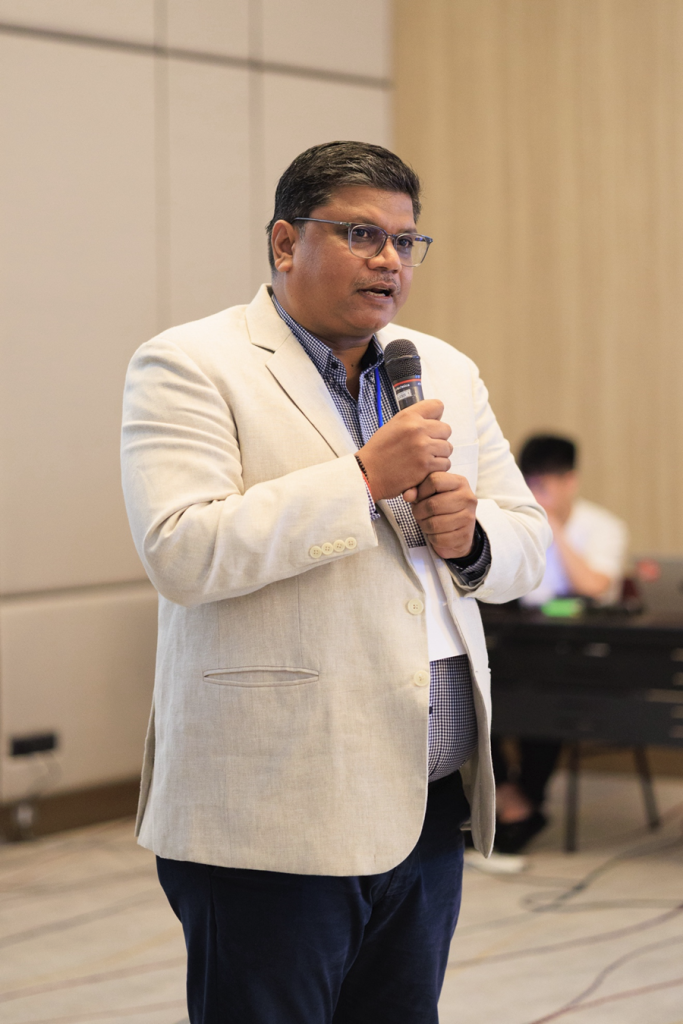
In his opening remarks, EIAP Regional Director Anand Singh noted that Southeast Asian education unions have not only been diligent in incorporating climate justice and a just transition into their union work, they have also imparted invaluable lessons to the EIAP network. “Hearing the news [about the climate crisis] can bring a sense of doom, especially as governments slash funds that could solve the twin crises of education and climate. But based on the good work of our brothers and sisters, I choose to believe in the power of our unions and collective action,” he said.
“Hearing the news [about the climate crisis] can bring a sense of doom, especially as governments slash funds that could solve the twin crises of education and climate. But based on the good work of our brothers and sisters, I choose to believe in the power of our unions and collective action”
Anand Singh, EIAP Regional Director