
Teach for Climate Action: How is climate change affecting the teaching profession
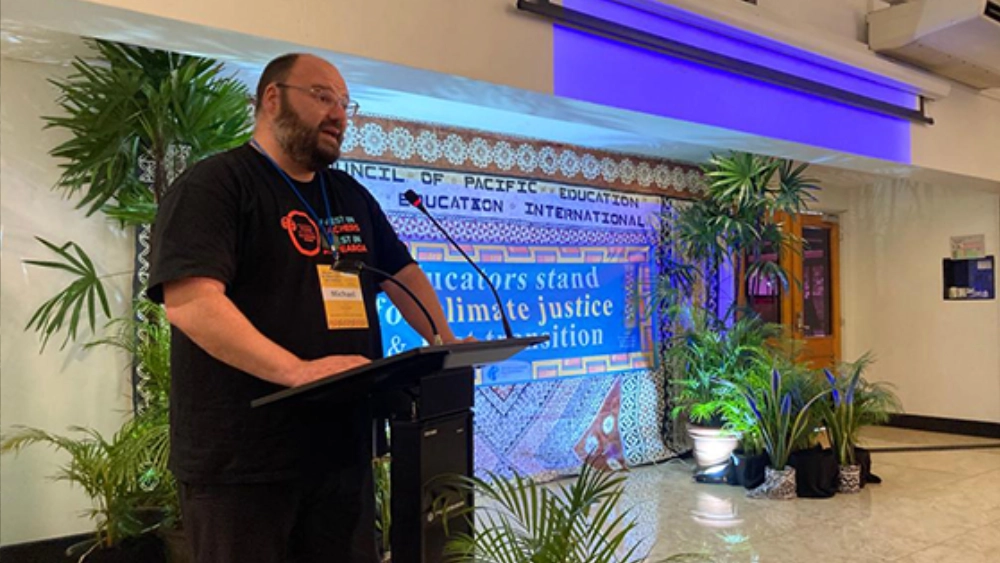
by Michael Waller, NZPPTA
This article was adapted from Michael Waller’s presentation at “Educators Stand for Climate Justice and a Just Transition” held in May 2023 at Lautoka, Fiji.
Ni sa bula vinaka, Ata Marie, talofa, namaste.
Ko Mākeo te maunga
Ko Waiaua te awa
Ko Te waka o Mataatua
Ko Omarumutu te marae
Ko Te Whakatohea te iwi
Ko te uri o Muriwai
Ko Hokitika a ho
Ko Michael toku ingoa
No reira, tena koutou, tena koutou, tena koutou katoa.
Climate change is already affecting the education sector in profound yet conspicuous ways. It is affecting our teachers, students, the curriculum and the biodiversity of our environments, which ultimately affects everyone.
In Aotearoa New Zealand, we pride ourselves on our local environmental curriculum, which seeks to reinforce a caring and symbiotic relationship between our students and the environment. We do this by providing tangible ways of experiencing and understanding nature. For example, the schools in South Westland on the West Coast of the South Island, which are nestled between the Coast and the famous Frans and Fox Glaciers, have built their whole school curriculum around these glaciers. From primary science, geography classes, to senior outdoor educational activities, students and teachers are learning together about the unique features of their local geography.
One practical yet important pedagogical practice is allowing students to climb and interact with the glaciers. However, owing to intensifying man-mad climate change, the glacier has receded a full kilometre in less than ten years. These days, only private helicopter tours are allowed a landing spot on the glacier. Students are no longer permitted access to the glaciers as part of the curriculum. In this case, climate change is directly affecting the curriculum as schools have had to dissolve blended, interdepartmental planning which was embedded from primary to secondary levels. It is also impacting the capacity of educators to effectively teach local ecosystems to students.
In Cobden West Coast, Aotearoa New Zealand, where I am teaching, communities have spent decades nurturing endangered species such as the indigenous, endemic West Coast blue penguin. Naturally, our students have been involved in building habitats and nest boxes and fending off invasive prey for these beautiful penguins. However, with climate change making severe weather events more prevalent, it was only a matter of time before one such event would wipe out a native forest that hosted these penguin colonies. For us, this was also a practical example of how climate change is affecting the teaching profession. Our students and whanau have felt this as trauma, with many of our young students reporting feeling that their life’s work was destroyed by man-made climate change. It is no wonder that guidance counsellors are reporting more students experiencing depression due to climate change.
The rapidness with which data sets are becoming obsolete is also affecting the ability of educators and researchers to conduct research efficiently. How can a researcher study the breeding habits of sea birds, when the data sets can hardly keep up with the unprecedented heatwaves destroying marine life as recently as three years ago? For instance, the previously mentioned blue penguins are changing their breeding patterns faster than the textbooks can publish updates. We are also seeing avian malaria in our sea birds at unprecedented rates. All of this is to say that our geography books and science textbooks cannot provide up-to-date information based on sound climate science, given the hastening climate impacts. Educators are then tasked to keep up with the latest scientific discoveries, lest we teach factually inaccurate lessons to our students.
On another practical note, extreme weather events are also making it more difficult to get students to attend school. In some cases, such as in Hamilton, falling school attendance due to massive storms and floodings have been worse than COVID-19 numbers. With severe weather events in New Zealand becoming more frequent, we are seeing more emergency school closures. Students have been forced to attend classes, often unsuccessfully, online.
May I offer the room the ultimate solution which could result in an 85 gigaton reduction of carbon dioxide emissions by 2050? The answer is to bring the estimated 132 million out-of-school girls across the globe into education. Educating our girls has more carbon reduction potential than the global onshore wind turbines at 47 gigaton or concentrated solar power predictions at 19 gigaton. For this seemingly ‘goldilocks’ solution we need only one thing kerekere: We need men and women in power to enact national public funding of education!
Michael Waller, NZPPTA
Coastal schools are also in danger of being closed or forced to move due to climate change. The latest water level modelling by the government suggests that sea level rise will soon reach these school buildings, with at least 100 schools being earmarked for closure. Such a scenario will affect not just students access to education but also educators’ livelihoods. This can have a ripple effect on the well-being, traditions, cultures and future prospects of certain communities, not least of which are the Indigenous Māori people.
So where does this leave us? How do we turn this daunting future into an opportunity to act and hope for a better world?
According to Shanti Jagannathan and Christina Kwauk, if only 16% of high school students in high and middle-income countries were to receive climate change education, we could see a nearly 19 gigaton reduction in greenhouse gas emissions by 2050. The correlation might not be apparent, but education has the potential to inspire climate activism. When students and their communities are sufficiently informed and educated, they will be empowered to demand swift and decisive climate action from governments. It seems that as educators our role is to inspire the younger generation to become more engaged in the fight against man-made climate change.
As I deliver this speech, I am reminded of the imperative in writing and public speaking to avoid repeating your words consistently. For one thing, I would like to apologize as I have used the term man-made climate change multiple times. However, this was intentional. May I offer the room the ultimate solution which could result in an 85 gigaton reduction of carbon dioxide emissions by 2050? The answer is to bring the estimated 132 million out-of-school girls across the globe into education. Educating our girls has more carbon reduction potential than the global onshore wind turbines at 47 gigaton or concentrated solar power predictions at 19 gigaton. For this seemingly ‘goldilocks’ solution we need only one thing kerekere: We need men and women in power to enact national public funding of education!
In summary, I would suggest that this man-made problem has a woman made solution.
Na mihi nui. Vinaka